

Most of us notice when text starts looking fuzzy. Changes at the edges of your sight often happen slowly, so they’re much easier to miss. Your optometrist can check that part of your vision with a field of vision test, often during a routine eye exam.
A field of vision test maps how far you can see around a fixed point without moving your eyes, along with how sensitive each area is to light. The results can reveal gaps in your peripheral (side) vision before you notice them yourself, making the test a useful tool for diagnosing and managing eye diseases like glaucoma.
What to Expect During the Test
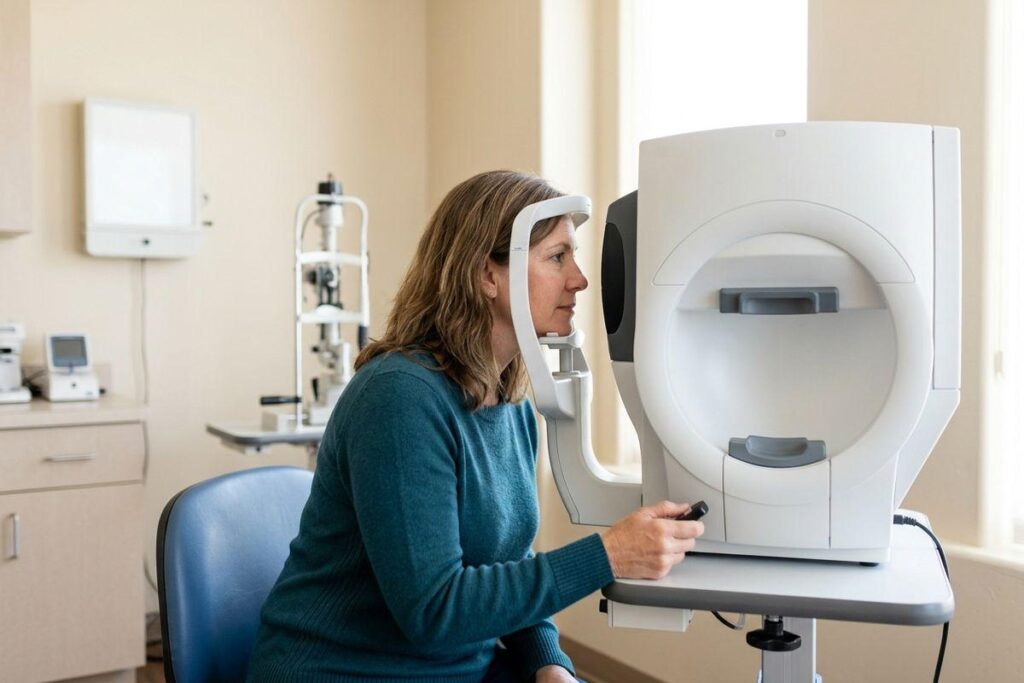
Most field of vision tests use an automated machine with a curved, bowl-shaped screen. You’ll rest your chin on a support and keep 1 eye covered while you look at a small light in the center.
Tiny lights will flash at different spots around that center point, some bright and some faint. Press the button whenever you see one.
The test is painless, and it usually takes 30 minutes or less for both eyes. Many machines track where you’re looking and note when your gaze drifts away from the center light.
Your responses create a map that shows where your vision is strong and where it may be weaker. Depending on what your optometrist wants to check, they may also use a simpler version of the test, such as asking you to look straight ahead and count fingers held off to the side.
Tips Before Your Appointment
Wear or bring your usual glasses or contacts, since the test checks how well you see with your correction.
Try to get a good night’s sleep before your appointment. When you’re tired, your reaction time can slow, and you might miss lights you’d normally see.
Once the test starts, keep your eyes on the center light, even if you feel the urge to look around. Only press the button when you see a light. Don’t worry if you miss some of them. The faintest lights are meant to be hard to see, and if you need a short break, let the person running the test know.
What the Results Can Reveal
Your results come back as a map of each eye’s field of vision. Your optometrist compares it with what’s typical for someone your age and looks for blind spots or areas where your sight is dimmer than expected.
These patterns can point to a range of conditions, including:
- Glaucoma
- Optic nerve damage
- Problems with the retina
- Stroke or other conditions that affect how the brain processes vision
The location and shape of a blind spot can give your optometrist clues about where a problem starts. Some of these conditions affect side vision well before they change what you see straight ahead, so finding them early can give you more time to start treatment or monitoring.
Why Field of Vision Testing Matters for Glaucoma
Glaucoma is often called a silent condition, and for good reason. damages the optic nerve and often has no early symptoms. It usually affects side vision first, and many people don’t notice a problem until they’ve already lost a lot of sight. Vision lost to glaucoma can’t be restored.
A field of vision test can pick up small gaps in your peripheral vision before you’d see them on your own. Your optometrist can pair it with other tests, like eye pressure checks and optic nerve imaging, to diagnose glaucoma.
If you’ve already been diagnosed, expect to repeat the test regularly. Each new map gives your optometrist something to compare it to, which can show whether treatment is keeping your vision stable.
Who Should Get a Field of Vision Test
Some people have a higher risk of glaucoma, which makes regular visual field testing especially worthwhile. Ask about it at your next eye exam if any of these apply to you:
- Adults 40 and older, when the risk for glaucoma and other conditions rises.
- Anyone with a family history of glaucoma.
- People living with diabetes or elevated eye pressure.
You don’t have to wait for a routine visit if something seems off. Book an exam if you notice new blind spots or keep bumping into things you didn’t see coming from the side.
Your optometrist can also tell you how often to get an eye exam based on your age and health history.
Make Your Side Vision Part of Your Next Eye Exam
Your peripheral vision does a lot of work in the background, whether you’re changing lanes or walking through a busy room. A field of vision test gives your optometrist a detailed look at that part of your sight and helps them spot changes early.
At Total Vision Solana Beach, our optometrists can include visual field testing in your eye exam and explain what your results mean for your eye health. Book an appointment and let’s take a look at your whole field of vision.